OpenAI, Anthropic and Block Join Linux Foundation to Advance Open-Source Agentic AI
The Linux Foundation has launched the Agentic AI Foundation (AAIF), a new open-source initiative seeded by major contributions from OpenAI, Anthropic, and Block.
These AI giants join the Agentic AI Foundation (AAIF) with OpenAI’s AGENTS.md specification, Anthropic’s Model Context Protocol (MCP), and Block’s goose agent framework.
This announcement matters because it moves several de-facto agentic building blocks into a neutral, vendor-neutral home where community governance, shared development, and interoperability can scale more easily than when each piece is stewarded by a single company.
That neutral supervision is intended to make it simpler for developers, researchers, and companies to build agentic systems that can work together across different platforms and tools.
The timing of this launch reflects clear momentum in the agentic-AI space: agent frameworks and protocols have matured rapidly over the past year, and the push to standardize how models connect to tools, data, and repositories addresses growing fragmentation that can slow adoption.
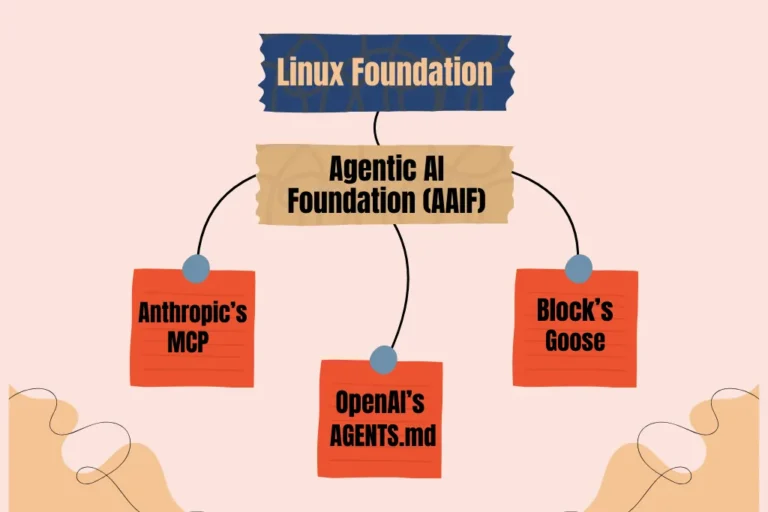
By centralizing MCP, goose, and AGENTS.md under AAIF, the ecosystem gains a shared foundation for interoperability, faster innovation cycles, and wider community contribution.
What Is Agentic AI Foundation (AAIF)?
The Agentic AI Foundation (AAIF) is a newly formed organization under the Linux Foundation dedicated to building an open ecosystem for agent-based artificial intelligence. Its core purpose is to create a shared space where developers, researchers, and companies can collaborate on tools, frameworks, and guidelines that make agentic systems more reliable, interoperable, and accessible. Instead of every company defining its own isolated approach, AAIF aims to establish open standards so that AI agents, tools, and models can communicate and work together consistently.
AAIF was created to address a growing challenge: as agentic AI evolves rapidly, the landscape risks becoming fragmented with multiple competing protocols, closed implementations, and limited compatibility across platforms. By offering a neutral, community-governed home for foundational projects like MCP, goose, and AGENTS.md, the foundation encourages transparency, interoperability, and shared development.
This approach lowers entry barriers, reduces duplicated efforts, and accelerates innovation across the AI ecosystem.
In simple terms, AAIF functions as a bridge, connecting technology providers and open-source contributors under a common mission: to standardize how agentic systems operate and interact, ensuring the future of AI agents is open, collaborative, and scalable.
Try AI Chat, an AI chatbot that writes essays and programming code, and analyzes images and documents.
What is the Role of Linux Foundation and Major Contributors
As the governing body, the Linux Foundation provides a neutral and collaborative environment for the Agentic AI Foundation to operate. Its role is to maintain open governance, ensure transparency in decision-making, and guide the development of standards that benefit the broader AI ecosystem rather than any single organization.
By placing AAIF under the Linux Foundation, the project gains long-term stability, open licensing stewardship, and a familiar community-driven development model that has historically accelerated growth for major open technologies like Kubernetes, Linux, and Cloud Native projects.
A key strength of this initiative lies in the collective involvement of OpenAI, Anthropic, and Block – three influential players pushing agentic systems forward. OpenAI’s contribution of AGENTS.md provides an early foundation for agent creation standards. Anthropic’s participation adds expertise in model reliability, safety, and scalable tooling for developers. And Block introduces goose, a practical framework for building and running AI agents, making hands-on experimentation easier.
Their collaboration signals a meaningful shift: instead of developing agentic systems in isolation, leading AI organizations are choosing to shape a shared foundation. This partnership matters because it aligns innovation efforts, minimizes fragmentation, and encourages the industry to move toward interoperable agent frameworks backed by open governance rather than proprietary silos.
Core Projects Anchoring the Foundation: MCP, Goose, and AGENTS.md
At the heart of Agentic AI Foundation are three major contributions: MCP, goose, and AGENTS.md. Each serves a different purpose, but together they form the technical backbone for building standardized, interoperable agentic systems.
Model Context Protocol (MCP) acts as a communication layer that enables AI models to connect with tools, databases, and external systems in a structured way. Instead of building custom integrations for every environment, MCP provides a universal protocol that lets agents request information, trigger actions, and work across applications. This solves a recurring challenge in AI development: making models interact safely and predictably with real-world software and data.
Goose, contributed by Block, is a framework designed to make the creation and execution of AI agents more practical. It offers a foundation for developers to script agents, define their tasks, manage execution, and test behaviors without reinventing agent infrastructure from scratch. Goose makes experimentation easier, helping developers move from idea to real, working agent faster.
AGENTS.md, shared by OpenAI, introduces a common specification for building agent architectures. It outlines how agents should behave, communicate, and handle tasks, like a blueprint for designing AI agents that others can understand and extend. With this, developers can follow a consistent structure that improves clarity, collaboration, and long-term compatibility.
When combined, these three projects lower fragmentation and move agentic AI toward a unified set of open protocols and frameworks. Instead of isolated approaches, the ecosystem gains shared standards that enable tools, models, and agents to work together regardless of who builds them. This interoperability is what allows AAIF to scale beyond individual contributors and become a foundation the wider AI community can build upon.
Why Agentic AI Matters Right Now
Agentic AI represents the next major leap in how artificial intelligence operates. Instead of responding only when prompted, autonomous AI agents are capable of planning tasks, taking actions, using tools, and working through multi-step workflows without constant human guidance. This evolution is shifting AI from a passive assistant into an active problem-solver, one that can manage research, generate code, process data, automate business tasks, and even coordinate with other systems.
The momentum behind agentic systems is driven by the growing need for automation at scale. Businesses and developers want AI tools that can not only analyze information, but also act on it – fetching data, interacting with software, writing reports, or executing commands. Agent-based architectures make this possible by enabling models to reason through tasks, break them into steps, and execute them independently or collaboratively.
Open-source innovation is key to unlocking this future. When agent frameworks and communication protocols are openly shared, the community can improve them faster, discover new use cases, and build tools that work together rather than compete in isolation. With AAIF supporting shared standards and interoperability, the development cycle for agentic solutions becomes faster, more transparent, and more accessible to everyone, from startups to research labs and independent developers.
So, agentic AI matters now because it moves intelligence beyond generating answers into performing actions, paving the way for autonomous workflows that transform how we work, create, and solve complex problems.
Impact of AAIF on Developers, Researchers, and Startups
The formation of AAIF opens significant new opportunities for developers, researchers, and startups working in the AI space. Instead of everyone building separate tools that don’t work well together, developers and teams now get access to shared standards and open frameworks. This means creating AI agents becomes easier, faster and more organized.
With MCP, goose, and AGENTS.md available under an open foundation, prototyping becomes faster, integrations become easier, and teams can focus more on innovation rather than infrastructure.
For developers, this means clearer protocols for connecting agents to tools, APIs, and data sources, removing the guesswork that often slows experimentation. For instance, a developer building a research assistant agent can use MCP to fetch documents or query APIs directly instead of designing a new integration system.
For researchers, open specifications make it easier to test models, compare results and collaborate with others. For example, a research team studying agent behavior can build on AGENTS.md and share improvements publicly, allowing others to test under the same structure.
For startups, this is even more valuable. Instead of building everything from scratch, they can use goose or MCP as ready-made building blocks to prototype ideas quickly. They stand to gain from reduced technical overhead. Instead of building entire agent stacks from scratch, they can leverage open frameworks, iterate rapidly, and bring products to market sooner. A small startup, for example, designing an AI email automation agent can plug into an open framework, test features in days instead of months, and push updates faster.
Struggling with your business? Fret not, we’ve a free AI Business Advisor for you, an AI tool to analyze every aspect of your business and provide tailored advice.
Shared standards also reduce fragmentation, which has been one of the biggest hurdles in agentic AI development. When the community builds around unified frameworks, interoperability becomes a default rather than an afterthought. This fosters an ecosystem where tools plug into each other, where improvements ripple outward, and where smaller teams can compete alongside industry leaders thanks to accessible open-source infrastructure.
AAIF creates a more level playing field, one where innovation is driven not only by scale but by creativity and collaboration.
How to Get Involved In Agentic AI Foundation: Resources, Repos & Community Links
Anyone interested in agentic AI can take part in this growing community. The Agentic AI Foundation offers open access to its tools, code, and discussions, making it easy for developers, researchers, and companies to explore or contribute. The main way to get started is by checking the project repositories, where you can find the source code for MCP, goose, and AGENTS.md along with examples and setup guides.
For those who want to contribute, the foundation provides clear instructions on how to share ideas, report issues, or help improve the tools. You can also join community channels, sign up for mailing lists, or attend virtual events to stay updated on progress and connect with others working on similar projects. Whether you write code, test features, or simply want to learn, every role supports the goal of building an open and collaborative agentic AI ecosystem.
Final Thoughts
The launch of the Agentic AI Foundation marks an important moment for the AI world. By bringing key projects like MCP, goose, and AGENTS.md together under the Linux Foundation, the industry now has a shared space to build smarter and more capable AI agents. This move encourages collaboration instead of competition, helping tools and models work together more easily.
As agentic AI continues to grow, open standards and community involvement will play a big role in shaping what comes next. With shared frameworks and an open environment for innovation, developers and organizations can build faster, experiment more freely, and create AI systems that are easier to connect across platforms. It’s a meaningful step toward a future where AI development is more open, cooperative, and ready to power the next wave of intelligent automation.

Albert Haley
Albert Haley, the enthusiastic author and visionary behind ChatGPT 4 Online, is deeply fueled by his love for everything related to artificial intelligence (AI). Possessing a unique talent for simplifying complex AI concepts, he is devoted to helping readers of varying expertise levels, whether newcomers or seasoned professionals, navigate the fascinating realm of AI. Albert ensures that readers consistently have access to the latest and most pertinent AI updates, tools, and valuable insights. Author Bio