Elon Musk’s OpenAI Lawsuit: Why Microsoft Was Added and Why Musk Lost
Key Takeaways:
The legal dispute between OpenAI and Elon Musk evolved into one of the most closely watched technology cases in recent years, drawing in major industry players including Microsoft.
What began as a disagreement over mission direction and governance eventually turned into a courtroom examination of how advanced artificial intelligence (AI) companies should be structured, funded, and controlled.
By mid-2026, Musk-OpenAI lawsuit reached a decisive turning point: a federal jury ruled against Elon Musk, dismissing his claims primarily on legal timing grounds rather than on the substance of his allegations.
That outcome reframed the entire narrative. Instead of a pending battle over AI governance, the case became a reference point for how courts may treat disputes involving nonprofit commitments, commercial scaling, and strategic AI partnerships.
Even with the verdict delivered, the case continues to matter. It exposes deeper tensions in the AI industry – between idealistic mission statements and the capital-intensive reality of building frontier AI systems.
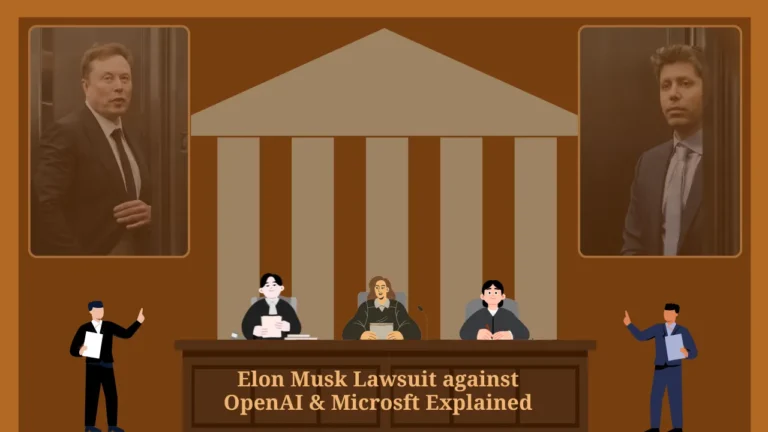
Did Elon Musk Win the Lawsuit against OpenAI?
In May 2026, a federal jury ruled in favor of OpenAI and its leadership, rejecting Musk’s claims against the company, its executives, and its strategic partner Microsoft. The decision came after a short deliberation and ended the trial phase of the dispute.
The key takeaway from the verdict was not a sweeping judgment on OpenAI’s mission or ethics, but a procedural conclusion: Musk’s claims were filed too late under applicable legal deadlines.
As a result, the jury did not need to fully evaluate whether OpenAI, the founder company of ChatGPT, had deviated from its original nonprofit intent or whether its commercial evolution was justified.
Why the Jury Ruled Against Musk
The jury’s reasoning centered on statutory timing rules rather than the broader philosophical arguments raised in the case. In legal terms, even potentially valid claims can be dismissed if they are not filed within the required time window.
This distinction is important. It means the verdict did not explicitly validate OpenAI’s strategy or invalidate Musk’s concerns. Instead, it concluded that the case could not proceed on procedural grounds.
The Statute of Limitations Issue
At the heart of the ruling was the statute of limitations. The court found that Musk’s claims were brought after the legally allowed period for challenging the relevant corporate actions and governance changes.
This effectively shifted the outcome away from a debate about artificial intelligence governance and toward a technical legal threshold. While the broader AI industry questions remain unresolved, the court determined that this particular lawsuit could not serve as the vehicle for addressing them.
Elon Musk’s Planned Appeal
Following the verdict, Musk indicated an intention to appeal the decision. However, appeals in cases involving statute-of-limitations rulings often face a high barrier, since appellate courts typically defer to factual findings made during trial unless clear errors are demonstrated.
What the Verdict Means for OpenAI and Microsoft
For OpenAI and Microsoft, the ruling removes a significant legal uncertainty. However, it does not eliminate ongoing scrutiny of AI governance models or partnerships between large technology companies and frontier AI developers.
The case has instead shifted from a legal dispute into a broader policy and industry discussion about how AI organizations evolve at scale.
Try the best ChatGPT Prompts for USA Independence Day to make it more interactive, engaging, and memorable for everyone involved.
The Origins of the OpenAI and Elon Musk Relationship
The roots of the dispute trace back to the founding of OpenAI in 2015. At the time, the organization was created with the intention of pursuing artificial intelligence research under a structure designed to prioritize public benefit over private profit.
OpenAI was initially established as a nonprofit research lab, attracting early support from figures including Elon Musk. Musk’s involvement included financial backing and advisory participation during its early development phase.
However, by 2018, Musk stepped away from the organization. His departure marked the beginning of a divergence in perspective. OpenAI moved toward scaling its research capabilities, while Musk increasingly expressed concern about the direction large AI systems were taking, particularly in relation to commercialization and centralized control.
Why Elon Musk Sued OpenAI
The Core Allegations
The lawsuit filed by Elon Musk against OpenAI and Microsoft centered on three major claims.
Taken together, these claims frame the lawsuit as more than a contractual disagreement. It is positioned as a dispute over whether OpenAI has remained faithful to its founding principles or transitioned into a different kind of organization altogether.
What is OpenAI’s Response to these Allegations
OpenAI argued that its evolution was not a departure from its mission but a necessary adaptation to the scale required for modern AI development. Training frontier models requires enormous computational resources, specialized talent, and long-term infrastructure commitments.
From this perspective, commercialization is not the goal but the mechanism that enables continued progress. Without significant capital investment, OpenAI and similar organizations would struggle to maintain competitiveness in a rapidly advancing field.
Why Microsoft Was Added to the Lawsuit by Musk
Elon Musk filed an amended lawsuit in California, adding Microsoft as a defendant alongside OpenAI and its CEO, Sam Altman. The lawsuit accused OpenAI of violating its foundational agreements and Microsoft of engaging in monopolistic behavior.

Microsoft became deeply involved with OpenAI through strategic investment and infrastructure support. Its Azure cloud platform serves as a core backbone for large-scale model training and deployment, making Microsoft a key enabler of OpenAI’s technical capabilities.
In addition, OpenAI’s models have been integrated into Microsoft’s ecosystem of products, ranging from productivity tools to developer services. This integration elevated the partnership beyond a traditional investor relationship.
This level of integration has led many observers to view the relationship as more than a typical vendor-client arrangement.
Learn also how Elon Musk’s launched AI humanoid robot Optimus will take jobs.
What are Musk’s Arguments Against Microsoft’s Role
Elon Musk’s amended complaint extended beyond OpenAI itself to question the nature and implications of Microsoft’s involvement. The central argument was that Microsoft’s deep financial and operational ties to OpenAI may have significant competitive effects within the broader AI market.
One line of concern focused on market influence. The argument suggests that when a major technology company provides both funding and critical infrastructure to a leading AI developer, it may indirectly shape the competitive landscape in ways that favor its own ecosystem. This included concerns about preferential access, strategic alignment, and potential barriers for other AI firms seeking similar resources.
Another concern raised in the case was related to competition in the rapidly evolving AI sector. As AI models become foundational to software products and services, the partnership between Microsoft and OpenAI has been interpreted by some critics as concentrating significant technological capability within a small number of companies.
Musk’s position framed this as a structural issue that could affect innovation and market fairness over time.
The amended Musk-OpenAI lawsuit ultimately positioned Microsoft not just as an investor, but as an entity with sufficient influence over OpenAI’s direction to warrant legal scrutiny within the broader dispute.
Microsoft’s Position to the Lawsuit
Microsoft maintained that its role was that of a strategic partner and investor, not a controlling authority. The company emphasized that OpenAI retains its own governance structure and decision-making autonomy, even as it relies on Microsoft infrastructure and capital resources.
Check also: Why Microsoft and Apple Quit OpenAI board seats.
Understanding Musk-OpenAI Lawsuit’s Central legal Issues
1. Nonprofit Versus For-Profit AI Development
At the core of the dispute is a structural question that extends beyond the specific parties involved: what kind of organization should develop advanced AI systems?
A central legal question was whether a nonprofit-origin AI organization can evolve into a hybrid structure without violating its founding commitments. The case highlighted tension between mission continuity and operational scalability.
2. Competition and Antitrust Concerns in AI Market
Another issue was whether deep partnerships between major AI developers and cloud providers could distort competition. As AI becomes foundational infrastructure, concerns about market concentration have intensified across the industry.
The concern highlighted in the lawsuit was not limited to individual company behavior but extended to broader market structure. When advanced AI development relies heavily on significant compute resources and long-term capital investment, partnerships between major technology firms can create concentrated centers of influence. This raised questions about whether such arrangements could limit competition or create barriers for emerging AI developers.
3. Governance and Control of Advanced AI
The Elon Musk-OpenAI lawsuit case also raised broader governance questions: who ultimately controls advanced AI systems when development, funding, and deployment are distributed across multiple entities?
In the context of this lawsuit, governance became a lens through which broader tensions are examined: between nonprofit oversight and commercial incentives, between independent research and investor influence, and between centralized control and distributed accountability.
Elon Musk – OpenAI lawsuit highlighted the challenge of defining control in a modern AI ecosystem where influence may be indirect but still structurally significant.
Major Court Developments in Musk-OpenAI Lawsuit
Early in the litigation, Musk sought an injunction to pause OpenAI’s restructuring process. The court rejected the request, allowing operations to continue while the case proceeded.
Importantly, the court clarified that the ruling did not address the validity of Musk’s underlying claims. It only determined that immediate intervention was not legally justified at that stage.
This distinction became a recurring theme: procedural rulings shaped the pace of the case, while substantive issues remained largely unresolved until the final verdict.
What OpenAI Lawsuit Means for the AI Industry
For startups, the case underscores the importance of access to compute and strategic partnerships. For investors, it highlights the complexity of funding organizations that combine nonprofit oversight with commercial execution. For regulators, it raises questions about whether existing frameworks are sufficient for governing AI systems that function as both infrastructure and product.
More broadly, it signals a shift in how AI competition is structured. The industry is increasingly shaped by a small number of deeply interconnected organizations, making governance and market structure central policy concerns.
What Happens Next in Elon Musk’s Lawsuit?
Although the trial phase has concluded, the legal story may continue through the appeal process initiated by Musk. However, even if appeals proceed, the broader industry implications are already in motion.
Attention is likely to remain focused on how AI companies structure governance, how partnerships between major firms evolve, and whether regulators introduce new frameworks tailored to frontier AI systems.
Discover OpenAI’s roadmap to AGI that provides 5-level AI development, from conversational systems to superintelligent ones that can run organizations.
Final Thoughts
The lawsuit between OpenAI and Elon Musk, with Microsoft drawn into its orbit, will likely be remembered less for its courtroom outcome and more for the questions it forced into public view. It highlighted the difficulty of balancing ambition with accountability in a field moving faster than most regulatory systems can adapt.
Even with a verdict delivered, the core tension remains unresolved in the broader industry: how to build powerful artificial intelligence systems without losing clarity over who controls them, who benefits from them, and how their direction is decided.
In that sense, the case does not close a chapter, it defines one in the ongoing evolution of artificial intelligence.
AI Tools
AI Marketing Tools
AI Business Tools

Albert Haley
Albert Haley is the author behind ChatGPT 4 Online, where he writes about artificial intelligence, AI tools, and the latest developments in the field. With a strong interest in making AI easier to understand and use, he focuses on explaining complex concepts in clear, practical language. His goal is to help readers understand new technologies, discover helpful tools, and keep up with developments that matter. Author Bio